


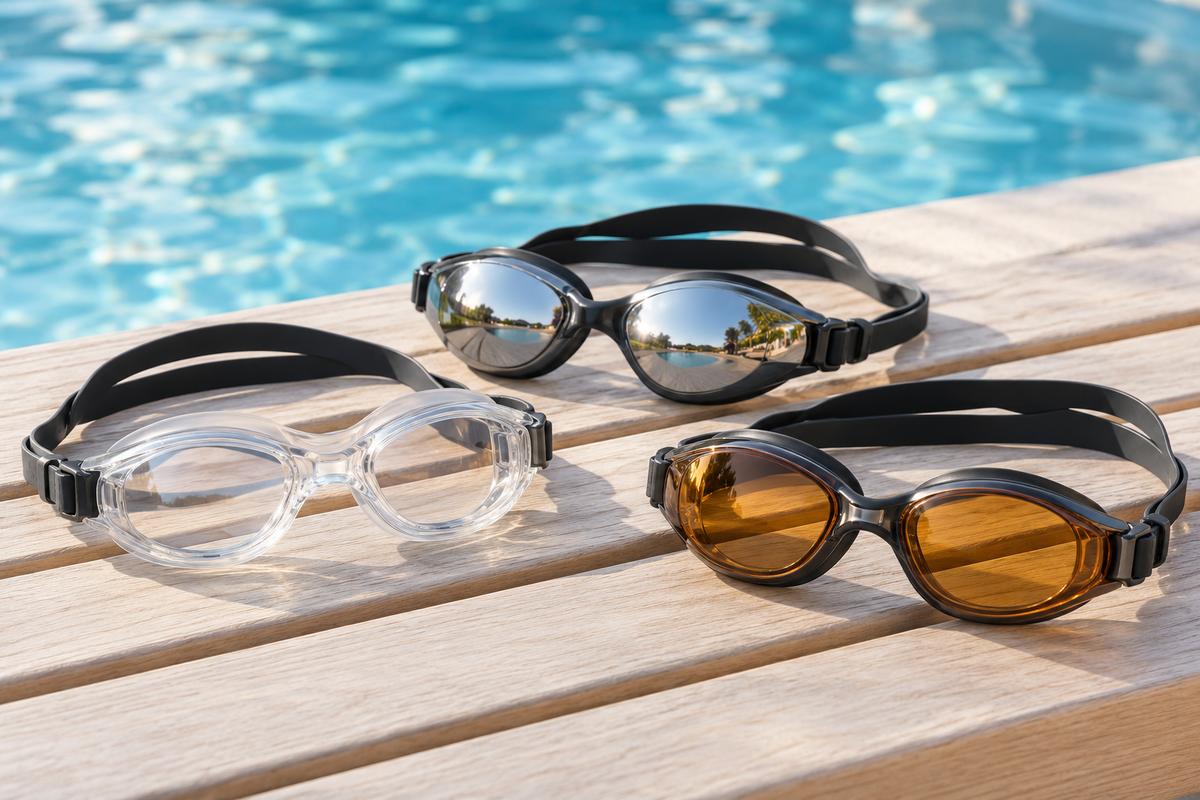
Two pairs of swimming goggles can have similar frames and very different lens descriptions. One says clear, another mirrored, and a third polarized. Those words do not describe a single ladder from basic to best.
Start with the light where you swim and read the complete lens specification for the exact variant. A bright outdoor pool, a dim indoor lane and changing open-water conditions can present different visibility problems. The most reflective-looking lens is not automatically the right answer for all three.
Clear lenses prioritize available light
Speedo's goggle guide places clear lenses with low-light conditions and indoor swimming. It describes mirror lenses as reducing brightness and glare, and smoke lenses as suited to bright conditions.
For a swimmer who finds an indoor pool already dim, choosing a darker view simply because the goggles look more technical can be unhelpful. Describe the problem before shopping: are you struggling with excessive brightness, or wishing you could see the lane markings more easily?
Do not judge the view solely from a front-facing product photograph. The appearance of the outside surface is not the same as looking through the lens. Where a retailer permits it, compare suitable options in person and ask how the selected lens is intended to perform.
Mirrored and polarized describe different features
Speedo Australia's lens guide explains that polarized lenses target glare from reflected light, including light reflecting from water. Mirror finishes also address bright conditions, but the words mirrored and polarized should not be substituted for one another.
There is a straightforward manufacturer example: TYR sells a model explicitly called Special Ops 3.0 Polarized Non-Mirrored. The name makes the distinction visible without requiring you to guess from a photograph.
If polarization is the feature you want, look for it in the specification of the exact lens option. Do not assume that silver, blue or rainbow reflections prove it. Likewise, a non-mirrored appearance does not rule it out.
Keep UV protection and anti-fog claims separate
A lens description can include several independent features. The TYR example lists embedded anti-fog and UV protection alongside its lens type. Read those claims individually rather than using color or the word polarized as a replacement for the full specification.
When comparing two versions of a frame, check whether the feature list applies to the selected variant or only to the product family. Save the exact model and color or lens code with your notes. If the listing is vague about a feature that matters to you, ask the manufacturer before relying on it.
This is also a reason to avoid broad claims such as “all dark goggles have the same protection.” The useful information is what the maker states for the particular pair you are considering, including intended use and care requirements.
Choose for the session you actually have
Write a short description of your normal swim: indoor or outdoor, typical time of day, and whether the light stays consistent. “Indoor evening lessons” is a more useful starting point than “I want the best lens.” So is “outdoor pool with strong afternoon glare.”
If your sessions vary, compare the compromises rather than forcing one label to solve every situation. Ask the retailer which options retain a usable view in your dimmest expected conditions and which address your brightest ones. You may decide that your current pair already suits most sessions.
For open water, lens selection remains only an equipment choice. It does not establish safe conditions, adequate supervision or a suitable route. Do not use a clearer-looking view through new goggles as a reason to extend a swim beyond your plan or ability.
A good lens still needs a suitable fit
Keep fit on the comparison list. A useful lens description does not tell you whether the frame and seal suit your face. Follow the manufacturer's fitting instructions and check comfort without overtightening the strap to compensate for a poor match.
Tell the retailer if you also need optical correction rather than choosing a tinted lens and expecting it to solve a prescription question. Lens tint, fit and corrective power are separate decisions. Use appropriate professional advice for vision needs.
Protect the view after purchase
Speedo's care guidance recommends rinsing goggles in clean cold water and avoiding wiping or rubbing the inside of its lenses. Follow your own model's instructions, particularly where coatings or special anti-fog treatments are involved.
Keep the goggles protected from loose objects in your bag. If the view becomes cloudy or distorted, investigate care, damage and the manufacturer's advice rather than assuming you bought the wrong tint. Do not try an abrasive cleaning shortcut to test that theory.
The best comparison is a complete sentence: the selected lens suits the expected light, its stated features meet your needs, and the goggles fit comfortably. That is more useful than choosing by the darkest color or shiniest finish.
Cover: an original illustration of different lens appearances. Color or appearance alone cannot establish polarization or protection.
 Water
Water