


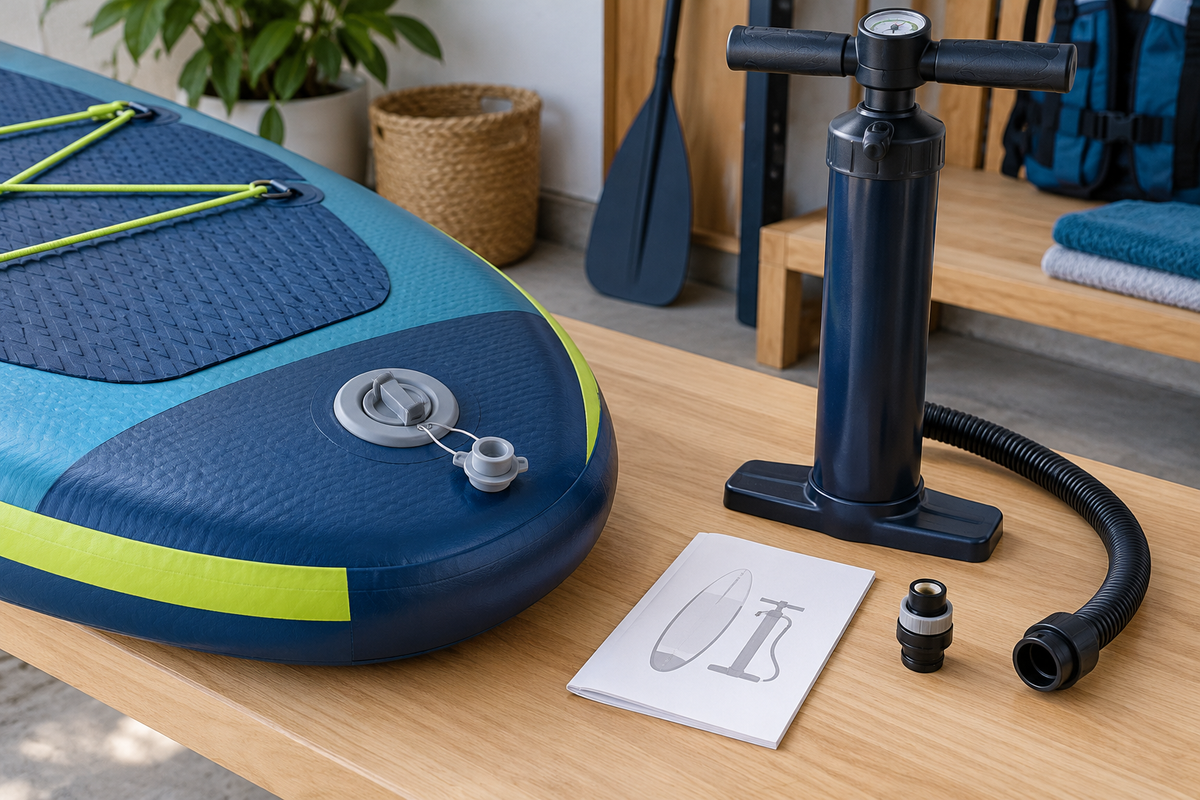
A replacement paddleboard pump needs to do more than look like the one that came in the bag. Its hose must connect correctly at both ends, its pressure capability must suit the board, and an electric model needs a power source you can actually use.
Before comparing inflation times or carrying handles, build a short compatibility record. It can help you replace one worn component instead of buying an entire setup that still needs another adapter.
Start with the board, not the pump listing
Write down the board maker, exact model and model year if known. Find its current manual and readable pressure label. Record the recommended operating guidance and maximum separately, including any different requirements for separate chambers.
The Sea Eagle LongBoard owner's manual, for example, distinguishes working pressure from maximum pressure and specifies a suitable pump and adapter. Those details apply to that board; they are evidence for checking your own model, not numbers to copy onto another SUP.
A pump's maximum output is not your board's inflation target. If the board information is missing or contradictory, resolve it with the manufacturer before choosing equipment around an assumed pressure.
Identify the exact valve and adapter
Photograph the accessible valve markings and the original hose-end fitting in good light. Keep a wider photograph showing the board model or label, so a supplier can connect the close-up to the correct equipment.
A broad family name may be incomplete. The NRS Halkey-Roberts identification chart distinguishes Old Short, New Short and Long versions and their fill adapters. “HR-style” in a listing should therefore prompt a more exact compatibility check rather than end it.
Ask for the manufacturer's part reference for the fitting and its specified seal or gasket. Do not assume a similarly shaped connector will lock and seal correctly. Keep valve disassembly and improvised trimming, filing or gasket stacking out of the shopping process.
Check the entire hose assembly
A fitting can suit the board while its hose does not suit the pump. Treat the connection as a chain: pump outlet, hose attachment, any intermediate join, and board-end adapter.
The Sea Eagle BP12ACC manual documents a threaded connection at the pump and a hook-in connection at the inflatable. That particular arrangement illustrates why a photograph of only the board-end tip is insufficient.
When buying a replacement hose, ask whether the listed part is a complete assembly and which pump models it fits. Confirm what comes in the package. A useful product description should let you identify the required connectors without assuming that loose pieces from different systems can be combined.
Separate pressure capability, gauge range and air volume
These specifications answer different questions. The NRS Super Pump is rated to inflate up to 20 psi while its included gauge extends to 30 psi. The highest number printed on a gauge is not, by itself, the pump's rating.
NRS also lists air volume per stroke separately. That is a useful reminder to compare pressure capability and air delivery as separate features, rather than reading one large number as proof of both power and speed.
Read how the gauge works on the proposed model. NRS says its Super Pump gauge reads while actively pumping and is no longer connected to chamber pressure when pumping stops. Do not generalize that behavior to every pump, or diagnose a failed gauge without checking its own instructions.
Put the board's requirements and the pump's specifications side by side. Leave any uncertain compatibility item open for confirmation instead of filling the gap with a seller's “universal” description.
Match an electric pump to the actual supply
Decide where you expect to inflate: beside the vehicle, at home or at a launch away from power. Then read the pump's permitted supply, connector and electrical requirements. A socket accepting a plug does not establish that it meets the pump's needs.
The BP12ACC manual is an example of a model specifying a 12-volt DC accessory supply and its own operating limits. For your chosen pump, check the run-and-rest schedule, weather protection and attendance requirements too. Do not improvise a wall converter, cable arrangement or battery connection.
A dedicated compatible electric SUP pump is different from adapting a workshop or tire compressor. Sea Eagle's LongBoard manual warns against those compressor types. Follow the board maker's restrictions and use equipment it approves for the job.
Turn the findings into one pre-order note
- Board model and chamber-specific pressure instructions
- Confirmed valve subtype and adapter reference
- Complete hose compatibility at both ends
- Pump-rated pressure capability and gauge instructions
- Required power source, if electric
- Included parts and any separate pieces still needed
Send that note with clear photographs when asking the manufacturer or supplier to confirm fit. Save the answer and exact product reference with your board records.
Once the equipment is confirmed, use the inflatable SUP setup routine to put it into the wider preparation process. The best replacement is a complete, documented match that you can use as instructed, rather than a collection of parts that almost connect.
Cover: an original editorial illustration, not a photograph of a specific product.
 Water
Water