


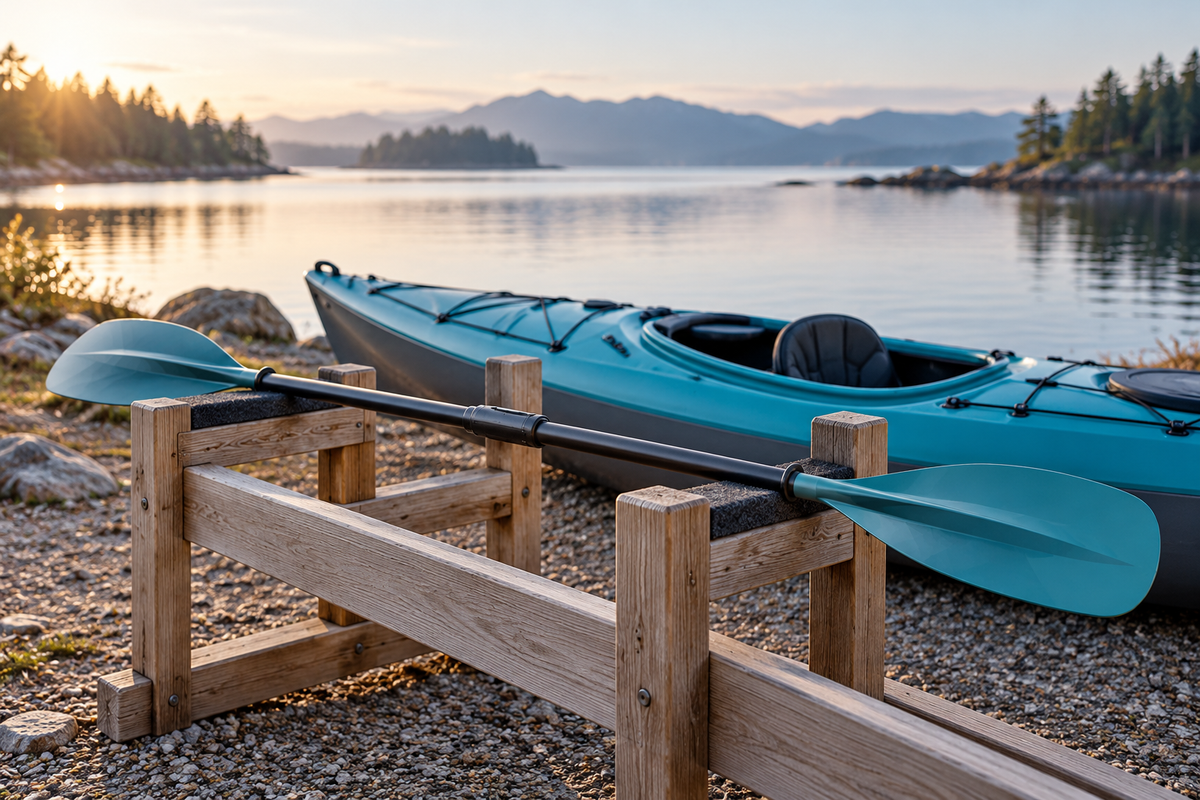
A kayak paddle may look crooked when its two blades do not face the same direction. That offset can be intentional. It is called feather angle, and it describes the relationship between the blades rather than the length of the shaft.
Understanding the setting is useful before buying a replacement paddle or borrowing one that feels unfamiliar. The goal is to know what the adjustment changes, how your particular paddle records it and what questions to bring to an instructor. There is no single angle that this guide can select for every paddler.
Feather angle is between the blades
Aqua Bound's explanation of feathering defines it as rotating the blades relative to one another at the shaft connection. With zero feather, the blades are matched rather than offset. A feathered configuration turns one blade's orientation relative to the other.
This is different from the angle at which you hold the whole paddle over the water. Rotating an entire assembled paddle in your hands changes its position, but it does not change the fixed relationship between its two blades. The feather setting is a property of that relationship.
It is also separate from paddle length. Some joints adjust only feather; some allow other adjustments too. If yours changes both length and feather, record both settings. Otherwise, you may think you are comparing two angles when you have also changed the reach.
High-angle paddling is a different use of “angle”
A listing for a high-angle paddle is usually describing the stroke style and associated blade design. It is not simply announcing that the paddle has a large feather offset. Werner's touring design guide discusses high- and low-angle designs separately from its adjustable ferrule.
Keep those terms in different columns when comparing products: intended paddling style, overall length, blade design and available feather settings. A product name that contains “low angle” does not tell you which setting is available at its center joint.
That distinction makes a conversation with a shop or instructor more productive. Instead of asking for “more angle,” say whether you mean a different stroke style, a different blade offset or a different paddle length.
The joint decides which settings are available
The joining section of a multi-piece paddle is often called the ferrule. Different designs provide different adjustment options. Aqua Bound describes snap-button positions as limited by the available holes, while other systems allow a wider choice. Werner describes specific increments for its Smart-View system.
Those examples are not universal specifications for all two-piece paddles. Read the instructions for the exact model and generation. Check whether any markings indicate left or right offset, and ask the manufacturer if their meaning is unclear rather than guessing from the way a product photo is oriented.
Practice recognizing the normal assembled and locked condition on land. Follow the manual's checks before use. If a connection does not engage as directed, has unexpected movement or appears damaged, resolve that issue before discussing which angle feels best.
Personal preference is not a wind rule
You may hear that feathering is simply a way to reduce wind resistance. Wind direction complicates that explanation. Werner's feathering FAQ points out that a headwind explanation does not transfer neatly to side winds or tail winds, and emphasizes matching the setting to the individual's paddling style.
Do not turn an equipment experiment into a reason to seek stronger wind. A number printed at the joint cannot make an unfamiliar or unsuitable outing appropriate. Discuss adjustment and technique in a controlled learning setting, with qualified instruction and the normal safety preparations for the activity.
Likewise, do not treat a recommended angle as a promised cure for wrist discomfort. Comfort involves more than one equipment setting. Stop a movement that causes pain and seek appropriate help rather than repeatedly forcing the same motion at new angles.
Make a comparison you can interpret
If an instructor recommends comparing settings, keep the same paddle, kayak and seat position. Change only the intended adjustment. Use a familiar, sheltered practice setting suited to the lesson, rather than adding an unfamiliar route or a longer trip at the same time.
Describe what you notice in ordinary language: whether the next blade seems ready for the stroke, whether you keep searching for its orientation and whether the movement feels comfortable. Those observations give an instructor more to work with than “this angle is advanced” or “that number is faster.”
Save a photo of the confirmed setting and note the paddle model. For shared equipment, check the setup again when it returns to you. Someone else's preferred adjustment may be perfectly reasonable for them while still feeling unexpected in your hands.
Feather angle is worth understanding because it is a reproducible equipment choice. Learn the terms, confirm what your joint permits and use instruction to evaluate the feel. The useful result is a setting you can explain and assemble correctly, not a universal number borrowed from another paddler.
Cover: an original editorial illustration of generic equipment, not a diagram specifying a recommended feather angle.
 Water
Water